Types of Window Blinds
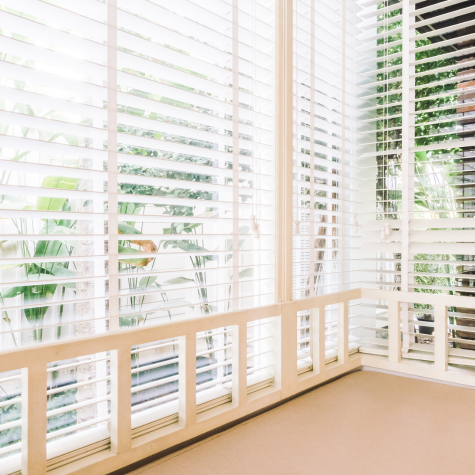
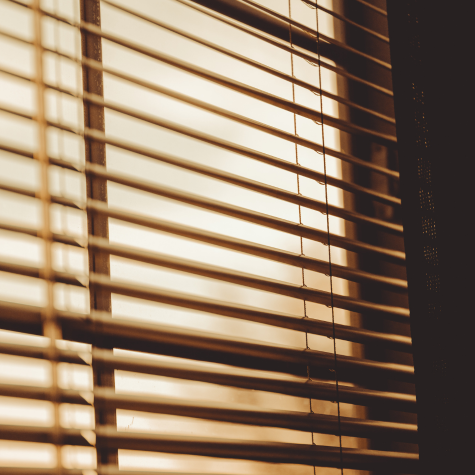
Venetian Blinds
Material: Aluminum, wood, faux wood, or PVC slats.
Design: Horizontal slats stacked together, adjustable to control light and privacy.
Operation: Cord or wand for tilting and lifting.
Vertical Blinds
Material: Fabric, PVC, or vinyl vertical slats.
Design: Slats hang vertically and are adjustable for light control.
Operation: Cord or chain mechanism for tilting and sliding.
Roller Blinds
Material: Polyester, vinyl, or fabric.
Design: A single piece of material that rolls up around a tube.
Operation: Manual (chain or spring-loaded) or motorized.
Roman Blinds
Material: Soft fabrics like cotton, linen, or blends.
Design: Pleats fold into sections when raised, offering a classic look.
Operation: Corded or motorized.
Cellular (Honeycomb) Shades
Material: Fabric in a honeycomb-shaped design.
Design: Traps air within its cells, offering insulation.
Operation: Corded, cordless, or motorized.
Pleated Shades
Material: Fabric or paper with a pleated structure.
Design: Collapses flat when raised.
Operation: Corded, cordless, or motorized.
Panel Track Blinds
Material: Fabric or woven materials.
Design: Large panels slide on a track, suitable for wide windows and doors.
Operation: Manual or motorized.
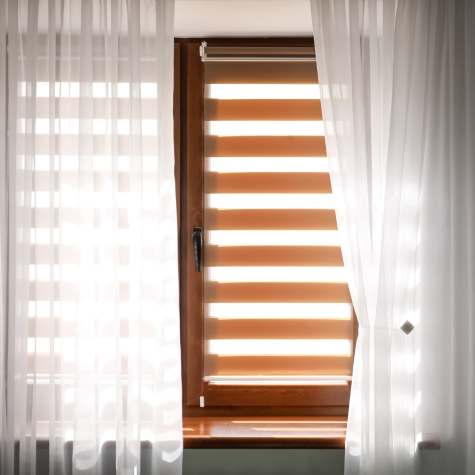
Zebra (Day-Night) Blinds
Material: Striped fabric with alternating sheer and opaque layers.
Design: Adjust by aligning the stripes for light or full privacy.
Operation: Chain or motorized.
Key Features
Light Control: Adjustable for partial or complete blackout.
Privacy: Options range from sheer to fully opaque.
Energy Efficiency: Certain blinds like cellular shades improve insulation.
Aesthetic Options:
Variety of colors, patterns, and materials to match interiors.
Decorative valances and trims.